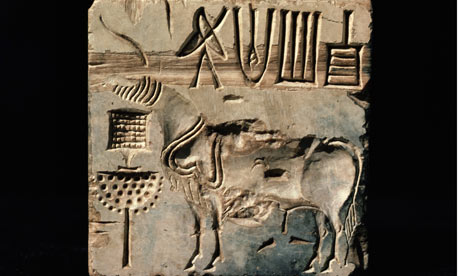
The similarity is so sharp that I’m forced to believe that both the scripts are sister scripts or something like that. For the first time, I felt that we are very near to understand the roots of Indus valley civilization.
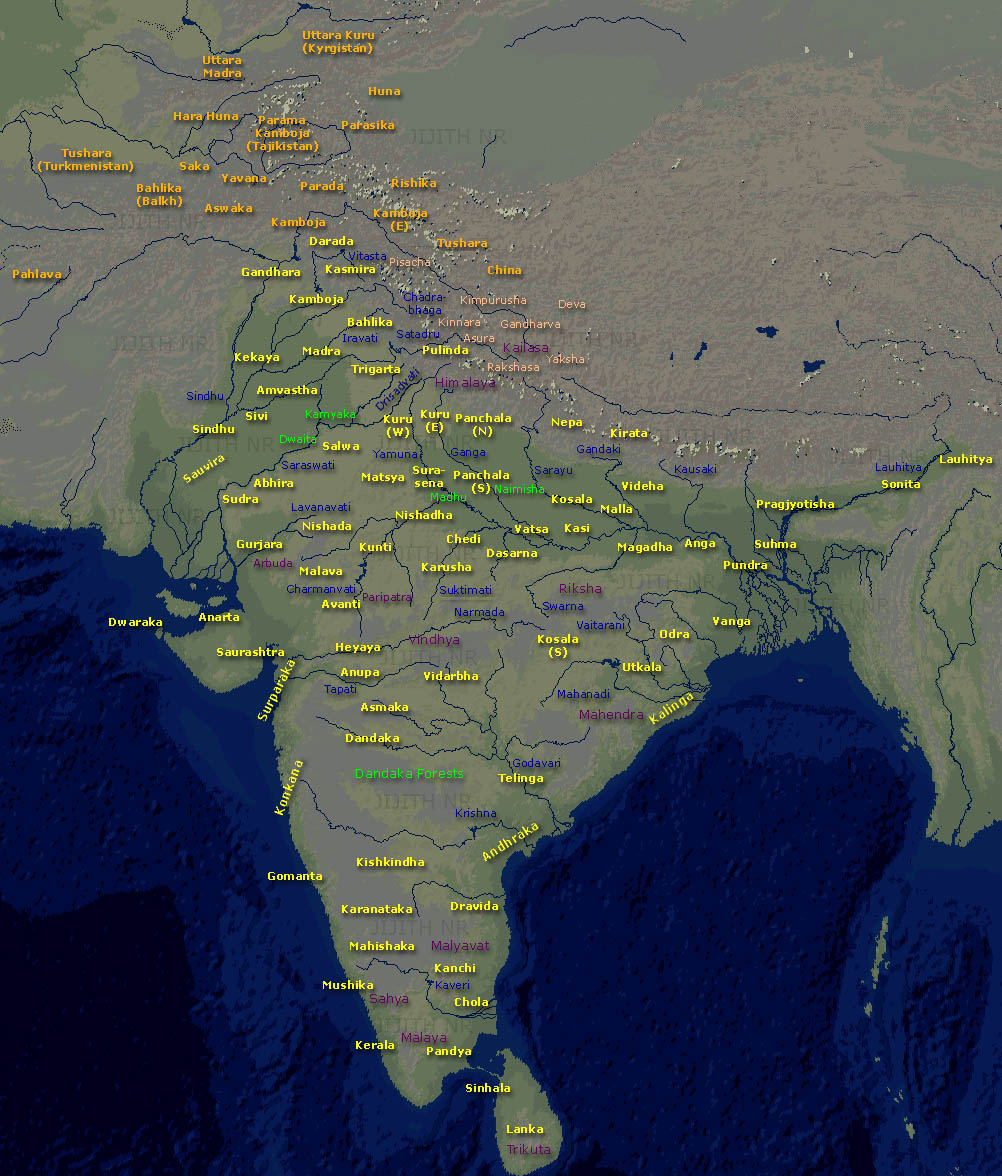
Indus valley civilization according to Mahabharata was kingdom of Sindhu, Kekaya, Gandhara, Amvastha,Sivi and Kamboja ; mesopotamia was pahlava[1]. They have mentioned been as Udichya. Also, there has been the mention of destruction of Vrishni and Andhaka clans by a destructive war weapon[4].

The ‘rann of kutch’ tells some story as well. The marshy, salty lands suggest that seawater once intruded the mainlands of this area.
When we consider Indian mythology, a new aspect comes under the picture. ‘Vashishtha’ was the guru of solar dynasty and also the guru of Rama. The solar dynasty included kekeyya, pahalava and others. Vashishtha has a cow called ‘kamdhenu’ which was considered extremely sacred and extremely powerful. Another cow like Goddess was worshipped by Egyptian called ‘Haroth’ which symbolises the universe. It is important to note that ‘vashistha’ emphasized in one God (Brahma) when he taught his principles to Rama.
Now, why I’m discussing cow. Is it related to religion?
No, it is just to emphasize the importance of the importance of Cow in both civilizations. Cow is the first alphabet of both in Hebrew and Indus valley civilization. Not only, it symbolizes Cow, but it represents the same phoneme.
Hebrew
אָ a
Indus valley
(head of) cow a (+-tu) possessive suffix
The similarity doesn’t end here. The Indus script was written from right to left, as it is the case with Hebrew or Arabic.
One more characters is important.
Hebrew
שׁ
sh
Indus valley
The symbol of great lord is nothing but trident, shinkal or trishul and the lord Shiv, sulin, sh..
Notably, the fire is a symbol which can be easily understood.
אֵשׁ
eysh
Fire
fire a symbol of shiva
אִשֶּׁה
ee-sheh
Fire offering
Now, the all powerful lord symbol has appeared, and the man is lying on the ground.
So, man symbol is pronounced ee which is a deviation from already known pronunciation ‘al/an’
man ee
man, servant
This opens a new hope to understand the ancient Indus valley scripts, which were earlier non-decipherable.
I suggest further similarities should be correlated, and we will have Indus valley script completely deciphered.
References:
http://upload.wikimedia.org/wikipedia/commons/e/e4/EpicIndia.jpg
http://www.harappa.com/arrow/Nilakantha-IM.pdf
http://www.ancient-hebrew.org/35_dictionary_01.html
http://en.wikipedia.org/wiki/Vrishni
First posted at my 2008 blog: http://jab2008.blogspot.com/2008/10/catching-up-geographical-languages.html


 BABU PRIYAVRAT
Leave a reply to sg Cancel reply