In April 2024, I wrote a detailed framework called HPSI (Hard-Power Sovereignty Index), under articles, ‘Three Pillars of Freedom’..
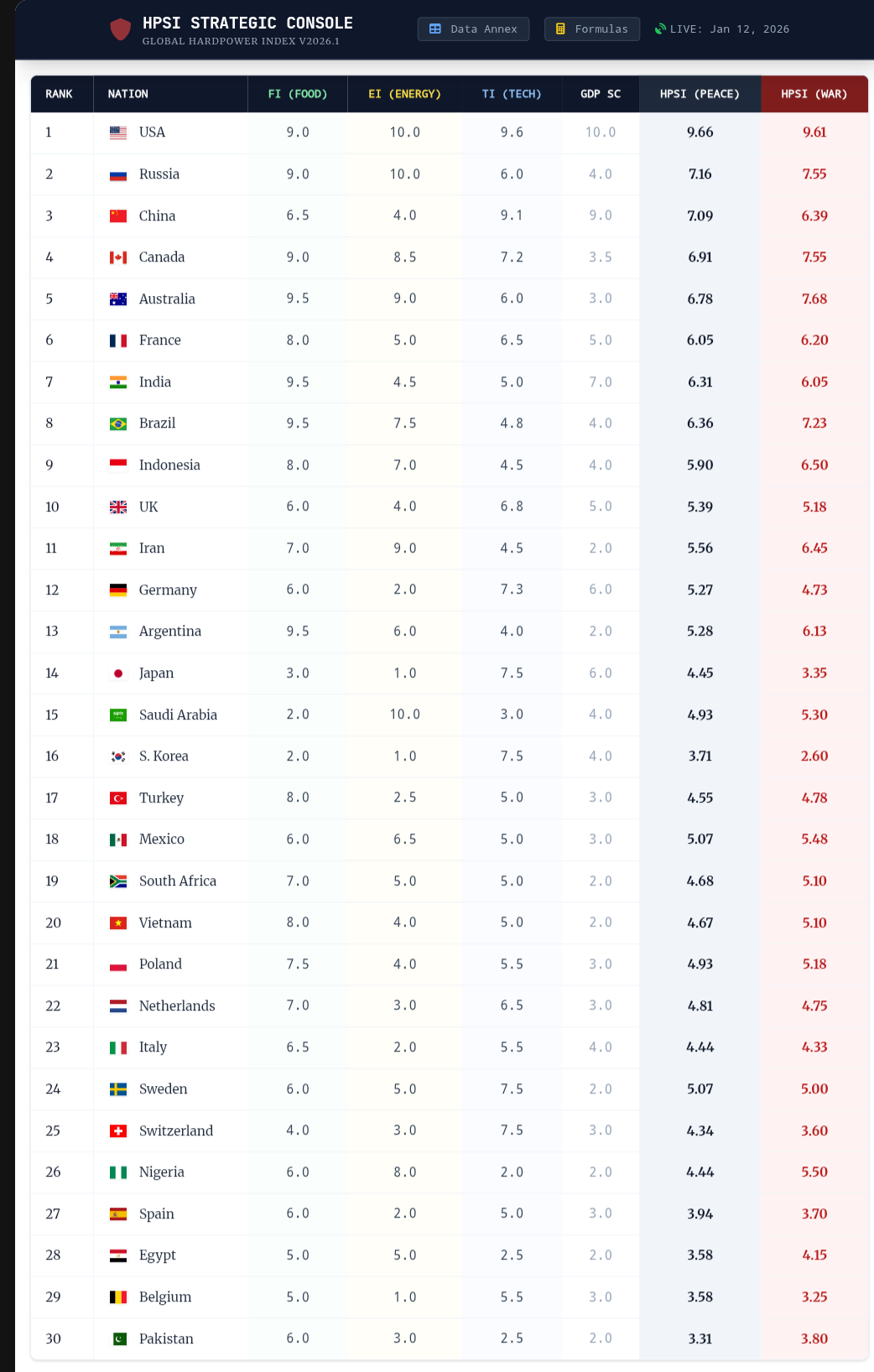
Try yourself what AI SUGGEST: HPSI CONSOLE
My recommendation was to form“blocs” mitigating risk and increasing bloc HPSI. The nature of recommendations remains the same.
SUMMARY
The US Hegemony is Volitional: By deregulating energy and mining, the US achieves a near-perfect HPSI score (9.66), becoming the only true superpower. It will further increase with GreenlanThe Hollow Giants: Germany and Japan, despite elite technology, possess “fragile sovereignty” due to near-zero energy and mineral independence.
Blocs Win Wars: Individual sovereignty is expensive. Resilience is now found in “Hardpower Blocs” (like AUKUS+ or the China-Russia Axis) that pool resources to eliminate deficits.
India’s Dilemma: Strategic Autonomy is acting as a drag on India’s potential, capping its Tech and Energy scores.
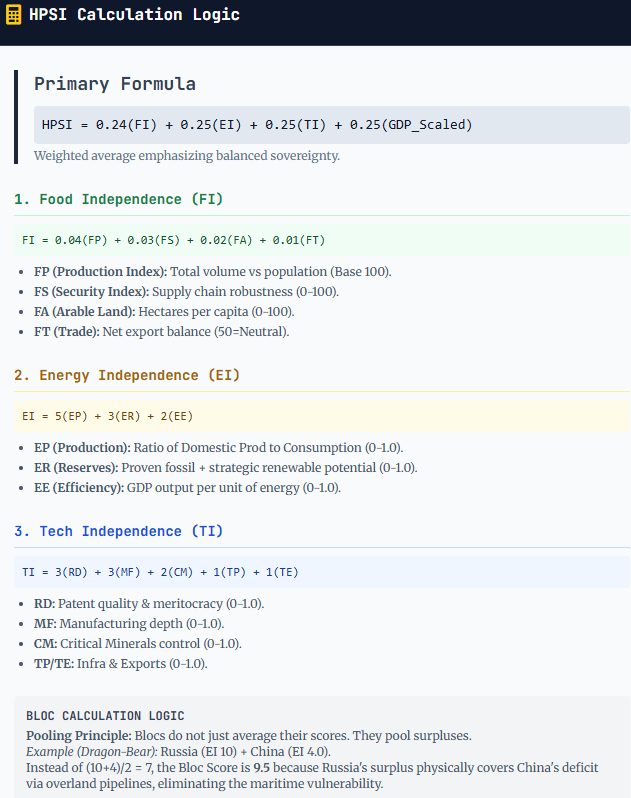
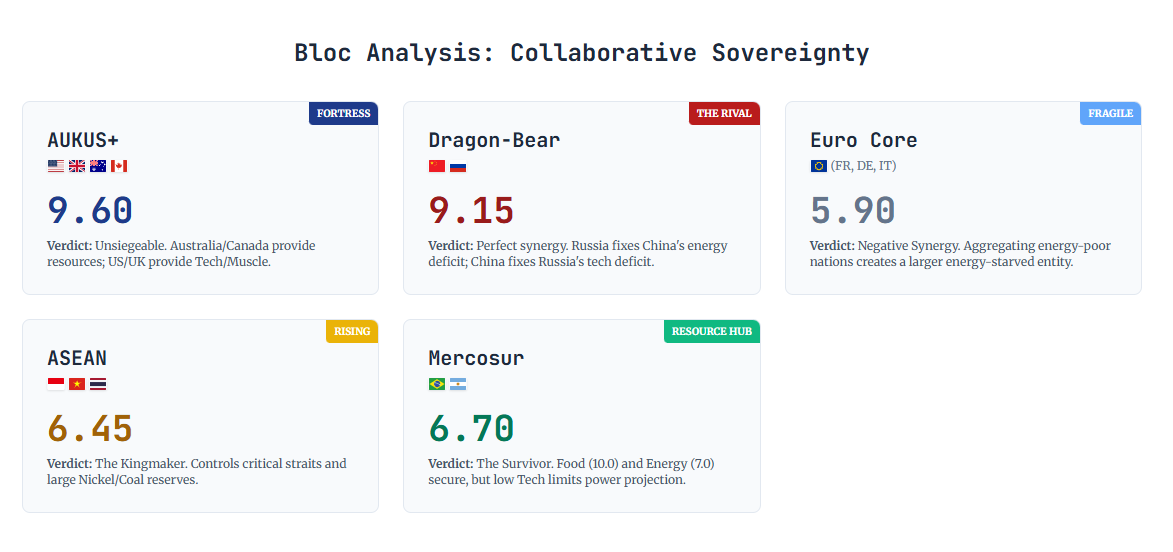
HPSI Calculation logic has modified a bit to add critical minerals in TI independence score.
1. Strategic Deep Dives: The Calculus of Power
United States: The Unshackled Hegemon
- HPSI Score: 9.66
- The Logic: The US is the only nation on earth with a “Royal Flush” of resources.
- Food (9.0): 128% self-sufficiency in cereals.
- Energy (10.0): The “Adjustment” unlocks 16M+ bpd oil production capability.
- Tech (9.6): Opening domestic mines (Nevada/Minnesota) solves the only weakness (Critical Minerals), raising the TI score from ~8.8 to 9.6.
China: The Processing Monopoly
- HPSI Score: 7.09 (Peacetime) / 6.39 (Wartime)
- The Logic: Powerful but fragile.
- Tech (9.1): Dominates processing (90% of REEs).
- Energy (4.0): The “Malacca Dilemma.” Imports 72% of oil. Blockade risk is existential.
- Food (6.5): 84% dependency on imported soy for protein (pork feed).
Germany: The Hollow Giant
- HPSI Score: 5.27
- The Logic: An industrial machine with no fuel.
- Tech (7.3): Elite R&D, but Critical Minerals score is near zero (0.05).
- Energy (2.0): 98% oil import dependency. De-industrialization is a mathematical certainty without cheap external energy.
2. The Rise of “Resilience Blocs”
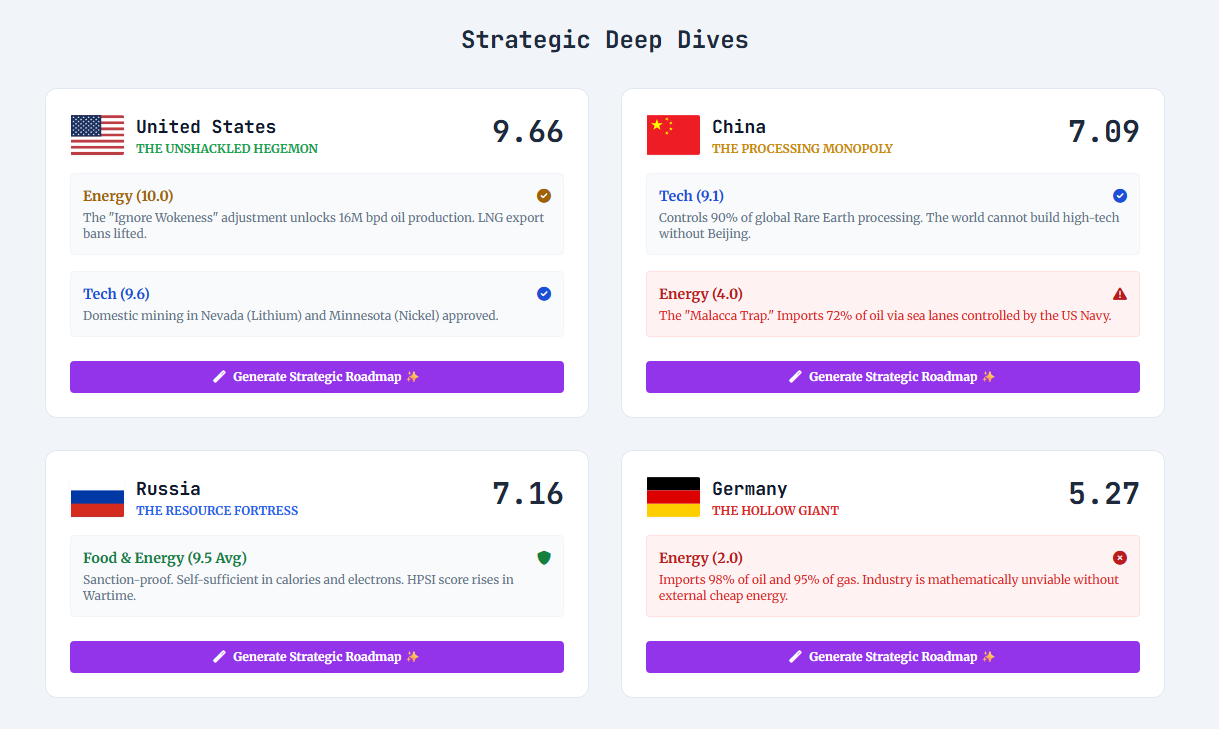
In 2026, nations are abandoning ideological alliances (like NATO) for “Hardpower Blocs” that pool food, technology and energy independence.
A. AUKUS+ (The Fortress)
- Members: USA, UK, Australia, Canada.
- Synergy: Perfect.
- Australia/Canada provide the Raw Materials (Food/Minerals).
- USA provides the Energy and Muscle.
- UK/USA provide the Intellectual Property.
- Bloc HPSI: 9.60 (Unsiegeable).
B. The Dragon-Bear (The Axis)
- Members: China, Russia.
- Synergy: Highly Complementary.
- Russia solves China’s Energy/Food deficit.
- China solves Russia’s Tech/Manufacturing deficit.
- Bloc HPSI: 9.15 (The only rival to AUKUS).
C. The European Core (The Fragile)
- Members: EU (France, Germany, Italy).
- Synergy: Negative. Aggregating energy-poor nations creates a larger energy-starved entity.
- Bloc HPSI: 5.90 (Fragile).
3. The Indian Dilemma: The Cost of Autonomy
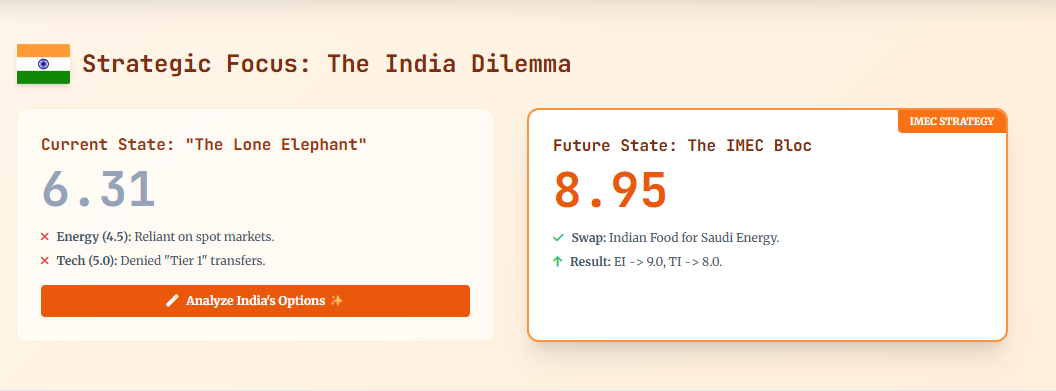
India occupies a unique position: A Food Superpower (FI 9.5) but an Energy/Tech lagger.
The Problem: The “Lone Elephant” Penalty
By maintaining Non-Alignment, India acts as a standalone entity in the index.
- Energy (4.5): Relies on the spot market. No “guarantor” (like China has Russia).
- Tech (5.0): Denied “Tier 1” tech transfers (nuclear propulsion, advanced jet engines) due to lack of treaty alliances.
The Solution: The IMEC Bloc
India must operationalize the India-Middle East-Europe Corridor (IMEC) as a Hardpower Treaty, not just a trade route.
- The Trade: India trades Food Security/Manpower (to Saudi/UAE/EU) in exchange for Guaranteed Energy (from Gulf) and Tech Transfers (from EU).
- Simulated Result:
- EI rises 4.5 to 9.0 (Secured supply).
- TI rises 5.0 to 8.0 (European tech integration).
- New HPSI Score: 8.95 (Elevating India to Superpower status).
4. The Nuclear Backstop: The Iron Ceiling of Conflict
While HPSI measures the capacity to win a war of attrition (blockades, sanctions, supply chain denial), the presence of strategic nuclear arsenals within each major bloc ensures that conflicts rarely escalate to total kinetic war or invasion.
HPSI determines economic survival and hierarchy. Nuclear weapons guarantee territorial survival.
The Deterrence Distribution:
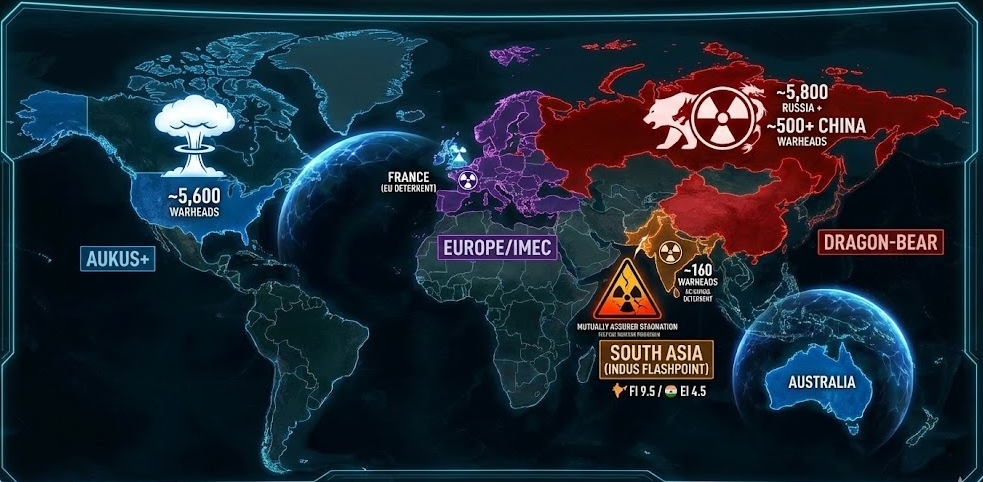
AUKUS+: Guaranteed by the United States and UK nuclear umbrellas (combined ~5,600 warheads).
Dragon-Bear: Russia’s massive arsenal (~5,800 warheads) combined with China’s rapid expansion (~500+ warheads) creates a peer-level deterrent against the West.
Europe/IMEC: France provides the independent deterrent for the EU; India provides a robust regional deterrent (~160 warheads) essential for the neutrality of the Global South.
South Asia (The Indus Flashpoint): The India-Pakistan dyad remains the most volatile flashpoint. While India’s superior HPSI scores (FI 9.5 / EI 4.5) grant it long-term conventional dominance, Pakistan’s tactical nuclear threshold creates a “Mutually Assured Stagnation.”
- The Sensor Risk: Recent Indian operations destroying Pakistan’s airspace sensors have created a temporary conventional window for precision strikes. However, this tactical blinding dramatically increases the risk of inadvertent escalation. If Pakistan is “blinded,” its decision-making threshold for releasing tactical nuclear weapons (NASR) lowers significantly out of fear of a decapitation strike, effectively negating India’s conventional HPSI advantage.
Non-protected Blocs
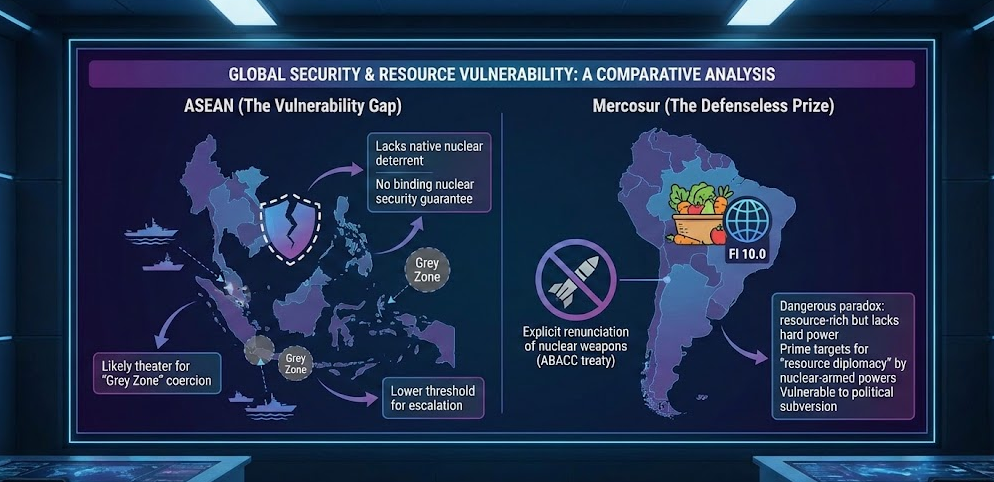
ASEAN (The Vulnerability Gap): Unlike the major power blocs, ASEAN lacks a native nuclear deterrent or a unified, binding nuclear security guarantee. This makes the region the most likely theater for “Grey Zone” coercion and proxy naval conflicts, as aggressors face a lower threshold for escalation here than in NATO or AUKUS territories.
Mercosur (The Defenseless Prize): Despite being the world’s most food-secure bloc (FI 10.0), Mercosur’s explicit renunciation of nuclear weapons (via the ABACC treaty) creates a dangerous paradox. It sits on the resources everyone needs but lacks the ultimate hard power to deter appropriation. This makes Brazil and Argentina prime targets for aggressive “resource diplomacy” or political subversion by nuclear-armed powers seeking to secure food supplies.
The Strategic Consequence: Because invasion is impossible due to Mutually Assured Destruction (MAD), the 2026 global conflict bifurcates. Between nuclear peers, it is fought in the “Grey Zone” of Resource Denial.
However, this immunity does not extend to the non-nuclear periphery. As demonstrated by the US invasion of Venezuela (Operation Absolute Resolve) to secure the Orinoco oil belt, great powers will utilize direct kinetic force to secure critical HPSI assets when the target lacks a nuclear deterrent. This confirms that HPSI imperatives override sovereignty norms in the absence of a “Nuclear Backstop.”
5. INDIA’s NUCLEAR DILEMMA: APPLICATION OF HPSI
The blinding of Pakistan’s airspace sensors has created a dangerous volatility. To mitigate the nuclear risk while retaining sovereignty leverage, India must apply HPSI principles:
- Technological Immunization (TI Upgrade): India cannot rely on “blinding” the enemy forever; it must nullify the enemy’s response. India must urgently leverage the IMEC Bloc (specifically Israel/France/USA) to acquire Tier-1 Ballistic Missile Defense (BMD) technology (Iron Dome/Arrow-3 integration).
- Effect: By creating a missile shield, India raises its TI score and neutralizes Pakistan’s “use it or lose it” nuclear blackmail, restoring the conventional advantage.
- Asymmetric Resource Warfare (FI Leverage): Instead of kinetic strikes that risk nuclear retaliation, India should weaponize its Food Independence (9.5).
- Action: As Pakistan faces climate-induced food shortages (low FI), India can exert pressure through water sharing (Indus Treaty modulation) or food embargoes on the region. This shifts the conflict from the “Nuclear Plane” (where India is vulnerable) to the “Resource Plane” (where India is dominant).
- Energy Resilience (EI Surge): The sensor conflict risks a wider war that could cut off oil supplies. India must operationalize the IMEC Energy Corridor immediately to ensure that even if the western border is aflame, energy continues to flow from the Gulf, allowing India to outlast Pakistan in a protracted mobilization.
6. Conclusion
The 2026 HPSI confirms that the era of “flat world” globalization is over.
- Geography is Destiny: Countries with dirt (Arable land/Mines) matters more than countries with bank accounts.
- Wokeness is a Strategic Vulnerability: Any policy that restricts domestic resource extraction (Energy/Minerals) directly lowers a nation’s sovereignty score.
- Integration is Survival: For the Global South, the choice is no longer “West vs. East,” but “Which resource bloc ensures my energy and food security?”
The United States, by embracing its hard power potential, has secured its hegemony. The rest of the world must now scramble to forge the alliances necessary to survive the blockade.

 BABU PRIYAVRAT
Leave a comment